Bitcoin’s recent price movements have been marked by significant volatility, with the cryptocurrency fluctuating around the $70,000 level. This volatility has been driven by a combination of factors, including macroeconomic trends, regulatory developments, and market sentiment. Despite this volatility, there has been notable selling pressure from both short-term traders and long-term holders in the market.
Currently, Bitcoin finds itself in a period of consolidation, with prices trading sideways above the $60,000 level. This consolidation suggests a temporary pause in the recent upward or downward trend, indicating a period of price stabilization amidst ongoing market fluctuations.
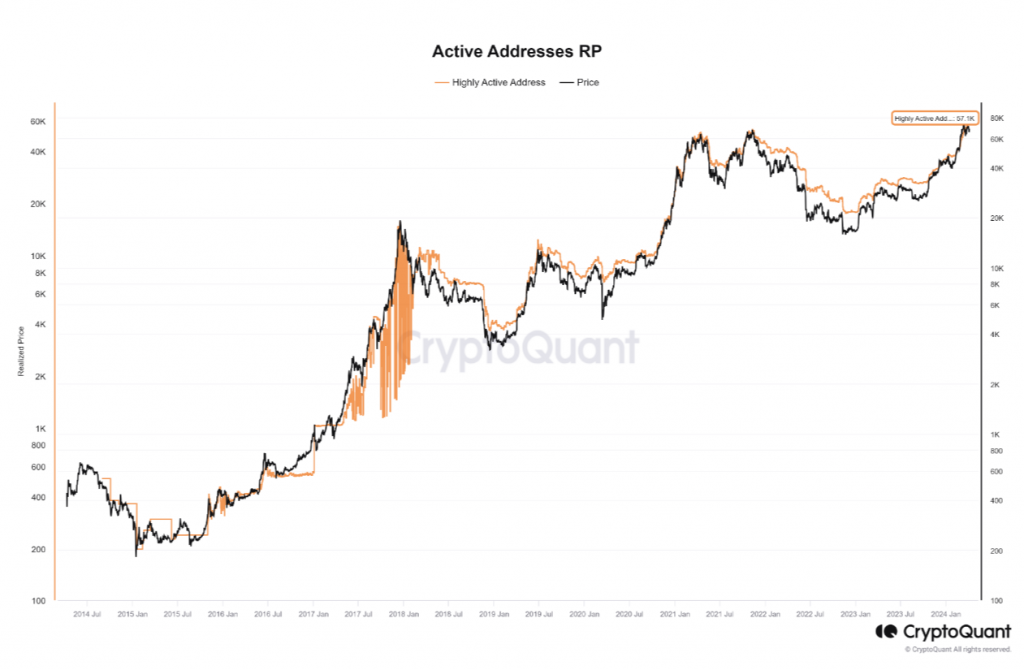
Analyzing the market from two key perspectives reveals important support zones. The first perspective looks at highly active addresses and their realized price. These highly active addresses represent significant transactional activity on the Bitcoin network and can provide insights into the behavior of short-term traders. The realized price of these addresses serves as a support zone, currently identified around $57,000.
The second perspective considers short-term and long-term holders (STH<H) and their realized price. These whales, who hold significant amounts of Bitcoin, often have a notable impact on the market. The realized price of STH<H whales provides another support zone, identified around $60,000.

As long as Bitcoin’s price remains above these support zones, the risk of major corrections and the breakdown of its short-term upward momentum is minimized. This consolidation phase offers an opportunity for Dollar-Cost Averaging (DCA) strategies, allowing investors to accumulate Bitcoin gradually at favorable prices.
Overall, while Bitcoin’s price may experience short-term fluctuations and periods of consolidation, its long-term trajectory remains influenced by factors such as institutional adoption, regulatory clarity, and macroeconomic trends. As investors navigate these fluctuations, understanding key support and resistance levels can provide valuable insights into market dynamics and potential trading strategies.